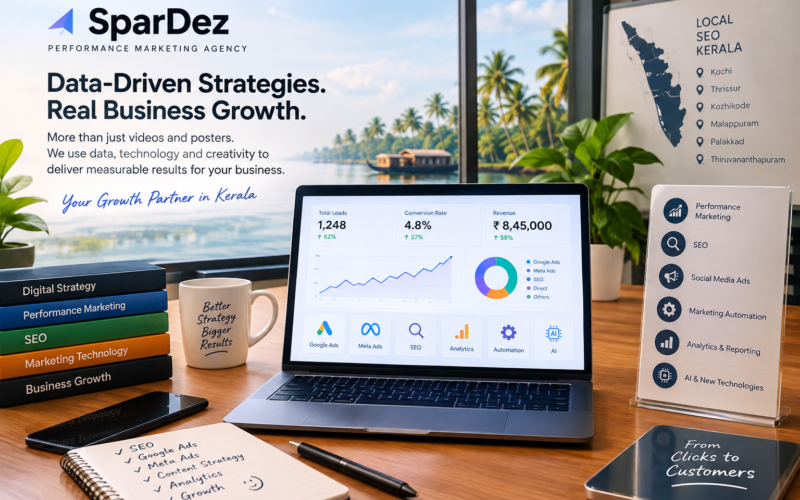
SparDez represents a modern approach to digital marketing where the objective is not simply to publish attractive content but to understand what happens after someone sees an advertisement, visits a website, submits a form, sends a WhatsApp message, makes a phone call or eventually becomes a customer. For businesses in Kerala, this distinction matters because digital competition has become much more sophisticated. A beautiful Instagram page can create attention, but attention alone does not necessarily create revenue. A professionally edited video may receive thousands of views, yet those views can have very little commercial value if they do not reach the right audience or lead people toward a meaningful action. A data-driven performance marketing agency in Kerala therefore needs to look beyond content production and examine the complete customer journey, from search intent and audience discovery to advertising, landing pages, lead quality, conversion tracking and optimization. SparDez can position its approach around that broader idea: marketing should be measurable, technology-enabled and connected to business outcomes. This means using SEO, paid advertising, analytics, automation, creative testing and modern AI-powered marketing technologies as parts of one connected strategy rather than treating each service as an isolated activity. Google itself continues to emphasize conversion goals, automation, audience signals and AI-powered optimization across its advertising ecosystem, demonstrating how quickly performance marketing is evolving.
Why Modern Businesses Need More Than Social Media Posts
Many businesses still judge digital marketing by counting the number of posters published every month or the number of videos uploaded to Instagram and Facebook. Content certainly has a role, but it is only one layer of the marketing system. Think of a business as a vehicle: creative content is the visible bodywork, while strategy, targeting, analytics, conversion tracking and optimization are the engine underneath it. You can polish the outside of the vehicle every day, but if the engine is not working properly, you are not going anywhere. The same principle applies to digital marketing. A company might publish twenty posters, ten reels and several promotional videos every month and still struggle to generate qualified enquiries because the audience is wrong, the offer is weak, the landing page is unclear or the campaigns are optimized for cheap clicks rather than valuable conversions. A modern performance marketing agency in Kerala needs to ask harder questions: Who is actually responding? Which campaign generates qualified leads? Which keyword produces commercial intent? Which location converts better? How much does an actual customer cost? Which creative attracts serious buyers rather than passive viewers? Those questions move marketing away from vanity metrics and toward measurable business performance.
The Shift From Content Creation to Business Performance
The digital marketing industry has changed from a simple publishing model into a much more measurable ecosystem. Earlier, businesses could be satisfied with having a Facebook page, posting regularly and occasionally boosting a post. Today, advertising platforms can use large quantities of signals to optimize campaigns around objectives such as leads, purchases and conversion value. Google’s Performance Max, for example, combines advertiser-provided creative assets, audience signals, conversion goals and AI-driven optimization across Search, YouTube, Display, Discover, Gmail and Maps. This means the role of an agency is increasingly about deciding what information to provide the platforms, defining the right conversion signals, building the right customer journey and interpreting the resulting data. Content remains important because advertisements need compelling creative assets, but creative is no longer the entire strategy. A strong campaign can involve keyword research, audience research, landing-page development, conversion tracking, CRM integration, retargeting, A/B testing and ongoing budget optimization alongside video and graphic design. For a Kerala business competing for customers in markets such as Kochi, Thrissur, Kozhikode, Malappuram, Palakkad or Thiruvananthapuram, this approach can make the difference between simply being visible online and building a repeatable customer acquisition system.
Why Data Must Drive Marketing Decisions
Data gives marketers a way to replace assumptions with evidence. Instead of saying, “This advertisement looks good,” a performance-focused team can ask whether the advertisement generated qualified enquiries at an acceptable cost. Instead of assuming that a particular audience is interested in a product, marketers can compare campaign results across locations, age groups, search queries, devices, creatives and conversion actions. This does not mean that every marketing decision can be reduced to one number; brand positioning, customer experience and creative quality still matter. However, data provides a feedback loop that allows the strategy to become smarter over time. Google describes Smart Bidding and AI-powered advertising as systems that use conversion information and real-time signals to optimize toward business objectives, reinforcing the importance of accurate conversion measurement. For SparDez, a data-driven marketing strategy in Kerala can therefore be structured around a simple principle: launch with a clear hypothesis, measure what happens, identify what is working, identify what is wasting budget, test alternatives and continuously improve the campaign. Marketing then becomes less like guessing which poster will perform and more like running controlled experiments designed to discover what customers actually respond to.
What Makes SparDez Different From a Traditional Digital Marketing Agency
The phrase “digital marketing agency” can describe very different types of businesses. One agency may primarily produce social media content, another may specialize in SEO, another may focus on paid advertising, while a more integrated agency may connect all of these disciplines into one growth strategy. SparDez can differentiate itself by presenting marketing as a performance system rather than a content calendar. That positioning is especially useful for businesses that have already experienced the frustration of getting likes, views and followers without seeing a corresponding increase in enquiries or sales. A modern agency needs to understand the entire path between exposure and revenue. That can include identifying the customer, understanding their intent, developing an offer, selecting the right channel, creating appropriate assets, directing traffic to a conversion-focused destination, tracking the interaction and feeding the results back into the next campaign. In this model, SEO and advertising are not competing services; they can complement each other. Organic search can capture existing demand, while paid campaigns can create reach and capture high-intent opportunities more quickly.
Beyond Videos, Posters and Likes
Videos and posters are tools, not marketing strategies by themselves. A business might have excellent creative content but still struggle if its campaigns are targeting people who have no intention of buying. The opposite can also happen: a simple advertisement with a clear offer can outperform an elaborate production because it reaches a highly relevant audience at the right moment. This is why performance marketing requires creative experimentation rather than simply producing more content. Different hooks, headlines, offers, formats, calls to action and landing pages can be tested against defined conversion objectives. For example, a jewellery company might test wedding-focused messaging against diamond investment messaging; a hospital might separate service-specific search intent from general awareness campaigns; a real estate company might distinguish property investors from home buyers. The creative strategy should follow the customer journey instead of forcing every potential customer into the same generic poster. SparDez’s message can therefore be built around a simple but powerful distinction: don’t create content merely to fill a social media calendar; create marketing assets that have a purpose within the customer acquisition journey.
Connecting Marketing Activity With Business Goals
A campaign becomes much more meaningful when its objective is connected to a real business result. A local education company may care about qualified admission enquiries rather than impressions. A car showroom may care about test-drive bookings and vehicle enquiries rather than video views. A healthcare organization may care about appointment requests, while an e-commerce business may care about purchases and revenue. Each objective requires different tracking and optimization. Google’s advertising documentation specifically emphasizes selecting meaningful conversion goals and assigning values where different conversions have different business importance. This is where a performance agency can add strategic value: it can help translate a broad business objective into measurable digital actions. Once those actions are properly tracked, campaign data becomes more useful because marketers can compare performance based on business relevance rather than superficial engagement. The result is a more accountable marketing process in which advertising budgets are connected to defined objectives, creative decisions are informed by evidence and future campaigns are improved using what the previous campaigns revealed.
Data-Driven Marketing Strategy for Kerala Businesses
Kerala is not a single homogeneous digital market. Consumer behavior can vary significantly between cities, districts, age groups, professions, income levels and product categories. A strategy that works for a premium jewellery brand may not work for an educational institution, and a campaign targeting customers in Kochi may require a different approach from one designed for a business serving smaller towns. A data-driven strategy begins by understanding the business’s actual market instead of copying a generic digital marketing template. Search behavior, website traffic, social engagement, enquiry patterns, geographic performance and previous advertising results can provide useful clues. Local language can also matter depending on the audience, with Malayalam, English or a combination of both potentially playing different roles across different customer journeys. A strong digital marketing agency in Kerala should therefore treat location as a meaningful marketing variable rather than simply adding the word “Kerala” to advertisements and website pages. The goal is to discover where demand exists, how people express that demand online and what message encourages the right audience to take the next step.
Understanding Customer Intent and Local Markets
Customer intent is one of the most valuable concepts in modern digital marketing. Someone searching for “best digital marketing agency in Kerala” is expressing a different level of intent from someone watching a general marketing video. Someone searching for “digital marketing agency Palakkad” may have a strong geographic requirement, while someone casually viewing a marketing reel may only be exploring an idea. Search engines, advertising platforms and analytics tools provide different types of signals that marketers can use to understand these journeys. Google’s current AI-powered Search advertising tools can expand search-term matching and use signals to identify relevant queries beyond traditional keyword matching. For a Kerala business, this creates an opportunity to structure campaigns around intent rather than relying exclusively on demographic targeting. A data-driven agency can analyze which searches, audiences and messages generate meaningful actions and then adjust campaigns accordingly. Local SEO adds another layer because businesses serving specific areas need to communicate their location, services and relevance clearly. The result is a strategy that recognizes that a customer in Kerala is not simply “an internet user”; they are a person with a specific need, location, context and reason for searching.
Building a Measurement Framework
Good performance marketing starts before the advertisement goes live. The first step is defining what success actually means and how that success will be measured. A measurement framework might include website traffic, engagement, leads, qualified leads, calls, WhatsApp conversations, appointment bookings, purchases, revenue and customer acquisition cost depending on the business model. Tracking should be designed so that marketers can distinguish between someone who merely clicked an advertisement and someone who completed a commercially meaningful action. Google recommends accurate conversion tracking and conversion-based bidding when advertisers want automated systems to optimize toward valuable outcomes. This makes tracking infrastructure an important part of modern marketing rather than an afterthought. SparDez can use this principle to build campaigns around measurable events and then use reporting to identify opportunities for improvement. When measurement is implemented correctly, the monthly marketing report becomes more than a list of impressions and clicks. It becomes a strategic document showing what happened, what changed, what was learned and what should happen next.
Performance Marketing That Focuses on Conversions
Performance marketing is fundamentally about measurable outcomes. That does not mean every campaign must produce an immediate sale, because customers often need multiple interactions before they are ready to purchase. A strong performance strategy can therefore account for different stages of the funnel, including awareness, consideration, intent, conversion and remarketing. The important part is knowing what each campaign is supposed to accomplish and measuring it accordingly. Google’s Performance Max framework illustrates how modern advertising platforms can optimize across multiple channels toward defined conversion goals using AI and real-time signals. For a business, this can mean that advertising is no longer limited to choosing a single placement and manually adjusting every bid. Instead, the marketer provides strategic direction, quality assets, accurate conversion signals and appropriate constraints while the platform handles parts of the real-time optimization process. SparDez’s performance marketing proposition can build on this evolution by combining human strategy with machine-powered optimization, while keeping business objectives at the center.
Meta Ads and Conversion-Focused Campaigns
Meta advertising can be valuable for businesses that need to reach specific audiences, generate enquiries, retarget website visitors or build demand around products and services. But the quality of a Meta campaign depends on much more than choosing an audience and uploading a poster. Creative testing, campaign structure, offer design, conversion tracking, landing-page experience and follow-up processes all influence the final outcome. A business selling high-consideration products may need a different funnel from a business selling an inexpensive consumer product. For lead-generation campaigns, the agency should also pay attention to lead quality rather than celebrating a low cost per lead if many enquiries are irrelevant. This is where data becomes essential. If one campaign produces 100 leads but only five serious prospects, while another produces 40 leads with 15 serious prospects, raw lead volume alone tells an incomplete story. A performance agency should help businesses look deeper into the funnel and connect advertising data with actual sales outcomes whenever the necessary tracking and CRM information is available.
Google Ads, AI and Automated Optimization
Google Ads is increasingly becoming an AI-assisted advertising environment rather than a purely manual keyword-bidding platform. Google’s current AI Max for Search campaigns can use expanded search-term matching, text customization and final URL expansion, while Performance Max can distribute campaigns across multiple Google properties and optimize based on conversion goals. Google reports that advertisers activating AI Max typically see 14% more conversions or conversion value at a similar CPA or ROAS, based on Google’s internal 2025 data for non-retail advertisers; this is Google’s reported average and should not be treated as a guaranteed result for an individual business. These developments demonstrate why agencies need to understand technology rather than simply repeat old advertising workflows. Human expertise remains important for selecting goals, preparing assets, interpreting reports, protecting brand relevance, checking landing pages and deciding where automation should or should not be used. SparDez can present this combination as human strategy plus marketing technology: technology processes signals and helps optimize campaigns, while marketers provide business context, creative judgment and strategic direction.
SEO in the Age of AI Search
SEO is changing, but it has not disappeared. Google Search Central’s current guidance explicitly states that foundational SEO practices remain relevant for AI features such as AI Overviews and AI Mode. Google recommends creating unique, helpful, reliable and people-first content while maintaining technical accessibility, crawlability and a strong website experience. This matters for any business positioning itself as an SEO agency in Kerala, because modern SEO cannot simply mean inserting keywords into articles. Search visibility increasingly depends on whether a website genuinely answers customer questions, demonstrates expertise, provides useful information and maintains a technically sound structure. AI search adds another dimension because people can now discover information through generated answers and conversational interfaces. Google’s own documentation says these experiences are grounded in Search systems and can surface links to relevant pages, meaning the fundamentals of being discoverable, useful and trustworthy continue to matter. A modern SEO strategy should therefore prepare websites not only for traditional blue-link results but for a broader search ecosystem.
Technical SEO and Search Visibility
Technical SEO is the foundation that allows search engines to discover, crawl, understand and process a website. Important areas include crawlability, indexing, internal linking, mobile usability, page experience, canonicalization, structured data where appropriate, site architecture and clean URL structures. Google explains that Search operates through crawling, indexing and serving, and that not every page will necessarily be indexed or served even when technical requirements are met. This means SEO should not be treated as a one-time task. Websites evolve, pages are added, technical issues appear, URLs change and competitors publish new content. A professional SEO strategy therefore requires ongoing monitoring and refinement. Google also recommends using Search Console to understand how websites perform in Search and to diagnose issues. For SparDez, technical SEO can become a core component of a broader performance strategy because organic search can provide long-term visibility while paid campaigns capture immediate demand. When technical foundations, content and commercial intent work together, SEO becomes part of the company’s customer acquisition infrastructure.
Content, E-E-A-T and Generative AI Search
Modern SEO content needs to offer something useful rather than simply repeating information that already exists online. Google’s guidance for generative AI search emphasizes unique, non-commodity content, first-hand experience, helpful information and people-first quality. This is particularly important as AI-generated content becomes easier to produce. If hundreds of websites publish nearly identical articles, simply creating another generic article may not provide much value. Businesses need to demonstrate why their information deserves attention. Case studies, original research, expert explanations, customer questions, local insights, product demonstrations and first-hand experience can make content more useful. SparDez can use this approach when developing SEO strategies for Kerala businesses by creating content that addresses real customer problems instead of manufacturing pages around every possible keyword variation. Google has also warned against producing large quantities of content primarily to manipulate search rankings. The future of SEO therefore belongs less to keyword stuffing and more to useful expertise, strong technical foundations, genuine relevance and a clear understanding of user intent.
New Marketing Technology Used by Modern Agencies
Marketing technology has moved far beyond scheduling social media posts. Today’s ecosystem can include analytics platforms, conversion tracking systems, CRM integrations, AI-powered advertising, automated reporting, customer segmentation, marketing automation, heatmaps, search intelligence, content systems and data visualization. The objective is not to use technology simply because it is new. Technology should solve a business problem or improve decision-making. If automation saves time but creates irrelevant leads, it has not solved the real problem. If AI generates hundreds of articles that nobody finds useful, the volume provides little strategic value. A modern agency therefore needs to distinguish between technology adoption and technology strategy. SparDez can position its technology approach around practical applications: identifying valuable audiences, improving campaign optimization, monitoring customer journeys, automating repetitive workflows and using data to make faster decisions. Google’s current advertising products illustrate this direction, with AI being integrated into targeting, bidding, creative optimization, reporting and campaign management.
AI-Powered Advertising and Automation
AI can now assist with several areas of digital advertising, including search matching, bidding, audience discovery, creative variations and campaign optimization. Google’s AI Max and Performance Max are examples of this evolution, where automated systems use signals from campaigns and conversion goals to make real-time decisions. But AI does not eliminate the need for marketers; it changes the marketer’s job. Instead of manually adjusting every small campaign setting, marketers can spend more time on strategic questions such as which customers matter most, which offers are commercially viable, what conversion signals should be prioritized and how the brand should communicate. Automation can also help reduce repetitive operational work, allowing teams to focus on analysis and experimentation. SparDez can integrate these technologies into performance marketing without presenting AI as a magic button. The best use of AI is not “let the machine do everything”; it is use the machine where automation is useful and keep human judgment where context matters. That balanced approach can make technology more practical for Kerala businesses of different sizes.
Analytics, Tracking and First-Party Data
Analytics is the nervous system of a performance marketing operation. Without reliable data, marketers may see that a campaign received clicks but have little understanding of what happened afterward. With appropriate tracking, a business can identify which channels contribute to enquiries, which landing pages create actions, which campaigns generate stronger prospects and where users abandon the customer journey. First-party data can become particularly valuable because it comes directly from the company’s own interactions with customers, subject to applicable privacy requirements and platform policies. A CRM, website analytics, call tracking, form data and purchase information can together create a much richer understanding of the customer journey than social media engagement metrics alone. Google’s advertising guidance also emphasizes conversion measurement and conversion values as inputs for optimization. For SparDez, analytics should therefore not be treated as a monthly reporting exercise performed after the campaign is finished. It should be embedded into the campaign from the beginning, creating a feedback loop where data influences targeting, creative, landing pages, budget allocation and future strategy.
Why Local SEO Matters for Kerala Companies
Local SEO can be especially important for businesses whose customers are concentrated within particular cities, districts or service areas. A restaurant, clinic, showroom, educational institution, real estate company, salon or professional service provider often needs to be visible when people search for a service with geographic intent. The opportunity is not limited to one keyword such as “digital marketing agency Kerala.” Users may search using city names, neighborhoods, service categories, product names, “near me” phrases and conversational questions. A strong local strategy therefore needs consistent business information, useful service pages, relevant location signals, a well-maintained Google Business Profile and content that genuinely explains what the business offers. Google’s Search documentation notes that business information and Business Profile data can contribute to how websites and businesses appear across Search experiences. Local SEO should also connect with broader content and reputation strategies rather than existing as a standalone listing-management task. For a performance marketing agency serving Kerala businesses, the opportunity is to combine local search visibility with paid campaigns and conversion optimization so that customers can discover the business through multiple digital paths.
Reaching Customers Across Kerala’s Major Business Markets
Kerala contains diverse commercial markets, and a digital strategy should reflect that diversity. A business operating in Kochi may have different competitive conditions from one operating in Palakkad, while a service company targeting Malappuram may communicate differently from a brand focused on Thiruvananthapuram. The same applies to industries: tourism, healthcare, jewellery, education, automotive, real estate, retail, hospitality and professional services each have different customer journeys. SparDez can build localized strategies by combining geographic data with audience behavior, search intent and conversion performance. Instead of assuming that one campaign should cover the entire state in exactly the same way, marketers can analyze which locations generate meaningful demand and adjust campaigns accordingly. This can include localized landing pages, location-focused SEO content, geographic advertising segmentation and creative variations where appropriate. The purpose is not to create hundreds of thin location pages simply for search engines; Google’s guidance emphasizes useful, people-first content rather than large volumes of low-value pages. The strongest local strategy is therefore one that reflects genuine service coverage and gives potential customers clear, useful information.
SparDez as a Full-Funnel Digital Growth Partner
A business rarely moves directly from seeing one advertisement to making a purchase. The customer journey may involve discovering a brand through Instagram, searching Google, visiting a website, reading reviews, comparing competitors, returning through a retargeting advertisement and finally contacting the company. A full-funnel approach recognizes these different stages instead of treating every customer interaction as identical. Awareness campaigns can introduce a brand, content can educate prospects, SEO can capture search demand, paid search can reach high-intent users, remarketing can reconnect with previous visitors and conversion-focused landing pages can make it easier to take action. The strength of this approach comes from connecting the stages together. Data from one stage can inform another: search queries can inspire content, landing-page behavior can inform creative testing and conversion data can influence advertising audiences. SparDez can therefore present itself not simply as a company that manages social media pages but as a digital growth partner using SEO, performance marketing, analytics, creative strategy and emerging marketing technology together.
From Awareness to Lead Generation and Sales
A full-funnel system begins by understanding the commercial objective and working backward. If the goal is lead generation, the agency needs to understand who qualifies as a good lead, what information should be collected and how quickly the business follows up. If the goal is e-commerce revenue, the strategy may focus on product discovery, shopping intent, conversion rate and customer value. If the objective is local appointments, location, service intent, calls and booking behavior may become more important. This is why there is no universal “best campaign” that works for every company. A strong strategy adapts to the economics and customer journey of the specific business. Google recommends aligning campaign goals and conversion tracking with the outcomes advertisers actually care about, allowing automated systems to optimize toward those objectives. SparDez can use this philosophy to create campaigns where every major activity has a role: SEO builds discoverability, content builds understanding, paid advertising creates or captures demand, landing pages encourage action, analytics measures behavior and optimization improves the system over time.
Conclusion: Building Sustainable Digital Growth With Data
The future of digital marketing in Kerala is moving beyond the simple idea of posting more content. Businesses increasingly need systems that connect SEO, performance advertising, analytics, automation, AI-powered technology, creative strategy and conversion optimization. Videos and posters remain valuable, but they work best when they are connected to a larger marketing objective. Data can show which audiences respond, which messages attract serious prospects, which channels contribute to conversions and where money is being wasted. Modern advertising platforms are also becoming increasingly AI-driven, making it important for agencies to understand how automation, conversion signals, audience inputs and creative assets interact. At the same time, Google continues to emphasize foundational SEO, helpful content, technical accessibility and people-first experiences for both traditional Search and emerging AI search features. For SparDez, this creates a clear positioning opportunity: a performance marketing agency in Kerala that looks beyond likes and content volume and focuses on building measurable digital growth systems. Businesses looking for an SEO or performance marketing partner should ultimately evaluate agencies based on their strategy, transparency, measurement framework, relevant experience and ability to connect marketing activity with genuine business objectives rather than relying on promises of guaranteed rankings or results. Google’s own guidance advises businesses to critically evaluate third-party SEO claims and notes that no external service can guarantee ranking success.